The streetcar project is well under way, but won't be ready until 2013. While the tracks have been laid and the streetscape project is just about complete, DC announced it won't be ready to run the program until 2013. DC is now in negotiations with Amtrak to use the area under the "Hop-Scotch Bridge" as storage for the streetcars, followed by construction of the storage facility.
DC Real Insight is a blog that comments on real estate, development, and community activities in the DC, Northern Virginia, and Maryland areas to help keep you up to date.
Wednesday, July 27, 2011
H Street NE, new Giant and Streetcars
The ever developing H Street corridor in NE continues to expand. A new development just broke ground last week on the 300 block of H Street, NE, which will be home to a new Giant (a 42,000 square foot store), 215 housing units, and all of this will be completed by 2013.
Looks like 2013 is going to be a big year for the H Street Corridor!
Monday, July 11, 2011
DC Metro Area Considered Hottest Housing Market in the Nation
It is well known the DC metro housing market sustained the recession better than most markets, especially Las Vegas and Florida. This is largely thanks to the federal government being the number one employer in the area. With fewer lost jobs than other areas in the country, buyers' confidence continued to hold steady thus allowing housing prices to remain relatively stable.
Now a report is stating the DC metro area housing market is to expected to end the year as one of the strongest in the country. Even though the market suffered since the peak in 2006 (losing about 42% of its value), our market is expected to regain one third of that by the end of the year.
We all know that depending on the area, prices have gone up or down, but overall, the market is showing signs of improvement. Now if you are looking to sell your home, this may be the time to consider. People selling their homes are starting to see multiple offers and some are actually receiving the asking price for their homes.
As a buyer, the news isn't as positive since prices are beginning to go up. Should you wait and see, I don't think that is necessarily a good idea since there are two factors at play here. The first being interest rates have begun to increase again, so you have to be careful of being priced out different areas. The second reason is the average sales price has increased since this past spring even though inventory is still not up to where it use to be in 2006.
The good news for buyers is it's not to late to get into some great investment areas (up and coming with development such as Shaw, 7th and O Streets NW, H Street NE, Petworth) since housing values are increasing again.
For more information on the report, please visit dcist.com.
Now a report is stating the DC metro area housing market is to expected to end the year as one of the strongest in the country. Even though the market suffered since the peak in 2006 (losing about 42% of its value), our market is expected to regain one third of that by the end of the year.
We all know that depending on the area, prices have gone up or down, but overall, the market is showing signs of improvement. Now if you are looking to sell your home, this may be the time to consider. People selling their homes are starting to see multiple offers and some are actually receiving the asking price for their homes.
As a buyer, the news isn't as positive since prices are beginning to go up. Should you wait and see, I don't think that is necessarily a good idea since there are two factors at play here. The first being interest rates have begun to increase again, so you have to be careful of being priced out different areas. The second reason is the average sales price has increased since this past spring even though inventory is still not up to where it use to be in 2006.
The good news for buyers is it's not to late to get into some great investment areas (up and coming with development such as Shaw, 7th and O Streets NW, H Street NE, Petworth) since housing values are increasing again.
For more information on the report, please visit dcist.com.
Wednesday, July 6, 2011
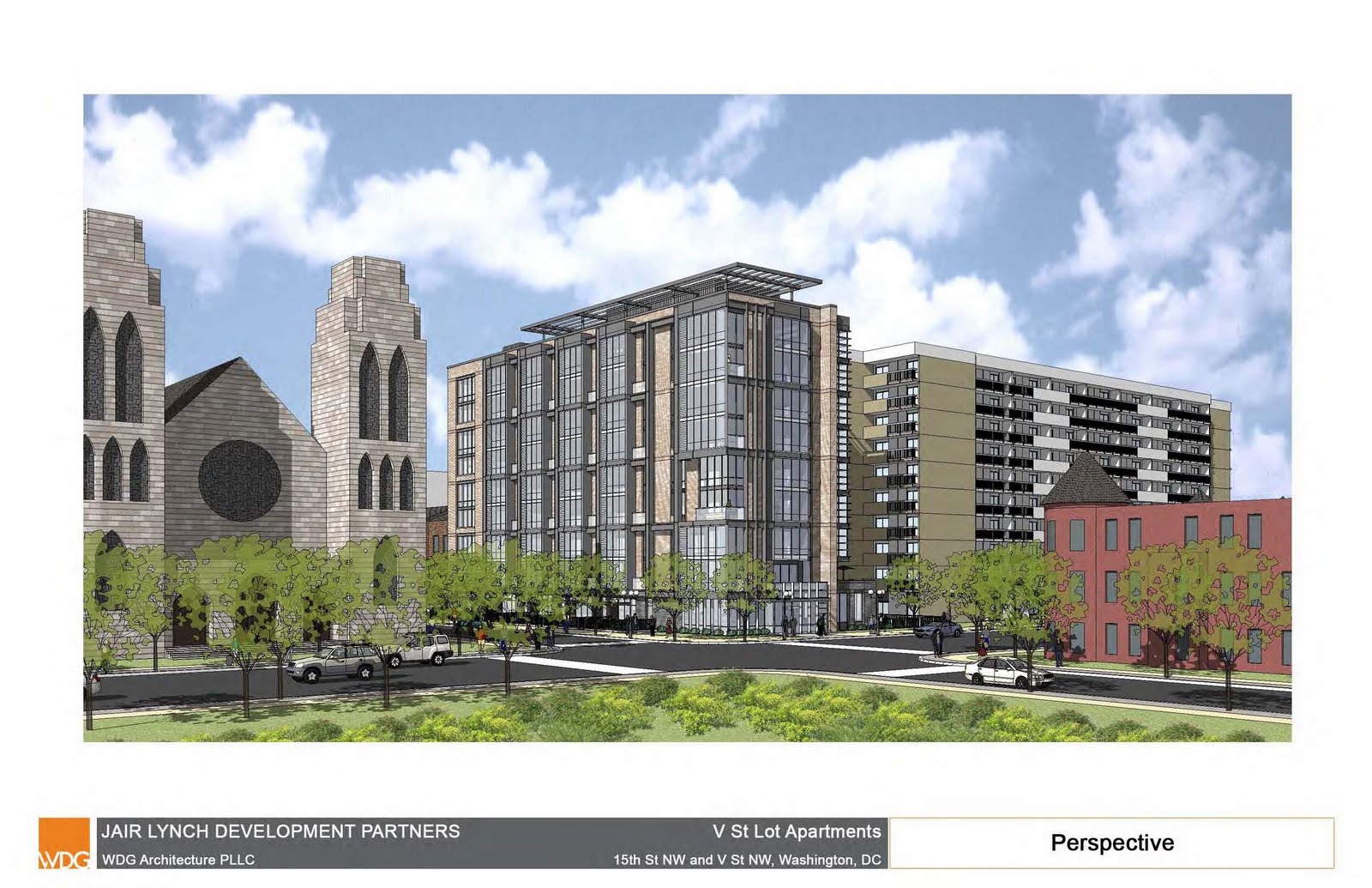
New condo building proposed for the corner of 15th and V Street, NW
Jair Lynch Development Partners, developer of Solea Condominium just a few blocks away, is proposing a 95-unit, 9-story residential building at the corner of 15th and V Street NW. The building, designed by WDG Architecture PLLC, is proposed on a portion of the existing parking lot for the Paul Lawrence Dunbar Apartment Complex which is home to affordable housing for senior citizens.
Some other quick facts at a glance:
- Units 95 condos
- Affordable housing 9 in new building (normally 8%)
- 90 feet high
- Parking will be incorporated underground for 48 spaces and an expanded parking lot for the apartments which are currently 21 will be increased to 30
- Groundbreaking next summer
- Project will be at least lead silver
Wednesday, April 20, 2011
Brookland Development Looks in Doubt
A developer planned on a 61' high mixed use development (901 Monroe Street) opposite of the Brookland Metro stop. The proposed site is now occupied by houses and a tavern, which the neighborhood does not want to loose.
Many say if the proposed development is built, the neighborhood would loose its character. The local ANC voted to designate the houses and tavern historical. If this goes through, then the development will not be possible at all.
This may be an emerging trend as neighborhoods try to push back development in order to presere their local character. So far, this is the only case, but we shall see as the economy improves.
Source: Washington Examiner
Tuesday, April 12, 2011
Another Round of Bids for the Florida Avenue Parcels
The Washington Business Journal reports that for a fourth time, Metro is once again looking for new bids to purchase the two parcels at 8th and Florida Avenue, NW, and one parcel at 9th and Florida Avenue, NW.
I spoke to Bob Burns back in January who was the contact for the RFP, he said there were three bids that were mixed use development. Later, it was published that JBG offered $11M ($6M more than the other two bids) to purchase the land. Looking at the tax assessment records, the lots are assessed at roughly $3.5M.
So why did WMATA reject the JBG bid if:
It was higher than the other two (by $6M)
Higher than the assessed land value of $3.5M
What are the technical aspects that caused all the bids to be rejected? Wouldn't these have been automatically removed before reaching the board for a vote?
Metro is bleeding money and this would have helped tremendously with its finances and helped the community by providing jobs and mixed use development. Why has there been no community meetings about this, and worse yet, Metro doesn't even work with the community nor its elected officials to keep everyone up to date.
Source: Washington Business Journal
- 2002: Metro reaches a deal with Howard University to develop the property. The deal fell through in 2003 due to litigation with another bidder.
- 2007: Metro leases the land to Banneker Venture Group, LLC, but withdrew the deal in 2010 after Banneker filed two extensions.
- 2010: Late in the year, Metro accepts three proposals after two extensions for the parcels. JBG is published as the highest bidder by $6M higher than the other two bids, one being Howard. However, the board voted to resubmit the bid since they site that none of the RFPs meet technical needs nor the assessed value of the parcels.
- 2011: Metro resubmits RFP in April
I spoke to Bob Burns back in January who was the contact for the RFP, he said there were three bids that were mixed use development. Later, it was published that JBG offered $11M ($6M more than the other two bids) to purchase the land. Looking at the tax assessment records, the lots are assessed at roughly $3.5M.
So why did WMATA reject the JBG bid if:
It was higher than the other two (by $6M)
Higher than the assessed land value of $3.5M
What are the technical aspects that caused all the bids to be rejected? Wouldn't these have been automatically removed before reaching the board for a vote?
Metro is bleeding money and this would have helped tremendously with its finances and helped the community by providing jobs and mixed use development. Why has there been no community meetings about this, and worse yet, Metro doesn't even work with the community nor its elected officials to keep everyone up to date.
Source: Washington Business Journal
Friday, April 8, 2011
City Center DC Breaks Ground After 8 Years of Delays
The new CityCenterDC development finally broke ground after nearly eight years of the city deciding what should go there.Originally under Mayor Williams, a new library was to be built on the former convention center site to replace the Martin Luther King Library on 9th Street.
The new project is one of the largest to date for DC, which includes 325,000 square feet of retail to be built during the first phase. It looks like DC will finally get a decent shopping area which it once had before the riots of 1968.
In addition to that, there will be a 350 room hotel, 443 apartments, as well as office space, all on a 10 acre parcel. This is a great example of mixed use development.
Thursday, April 7, 2011
Howard University Presents Drafted Ten Year Plan
All universities in DC are required to submit a ten year plan. Howard has already shared it with DDOT in order to discuss closing a couple of blocks off to traffic, as well as new sidewalk routes for students.
Currently, Howard has about 10,000 students and has in the past been up to 12,000. They have a serious shortage of housing for students, especially for freshmen and sophomores, with only a total of 4,600 beds available for all students now. Three buildings are immediately off campus, two the south and one to the north. Both are inconvenient for students to get to campus, and don’t even have air conditioning.
Howard is proposing to initiate a three phase process which will greatly revitalize its campus. In order to prepare for this, Howard has done an extensive engineering study, worked with faculty, as well as local residents. The result is a three phase program (see timeline below) that will address three crucial areas:
1) Add more housing on campus for students and new faculty which will improve the student life experience
2) Increase the number of labs for S.T.E.M. and other sciences so Howard can be ranked number one in research again (currently number two for its division).
3) Address the crumbling infrastructure of existing buildings
The first phase will concentrate on adding student housing which will add 1,300 new beds. Once they are completed, the three exiting dorms outside of campus will be repurposed, possibly for faculty housing (about 800 beds). There are also two proposed research buildings. All the new buildings are to be built on existing parking lots, and the goal is to begin to grow Howard more west of Georgia Avenue.In order to address the possible growing parking problem in the community, Howard has already begun a transportation reduction plan. However, the design review committee stressed Howard provides a more detailed parking plan in the near future.
It was also brought up by the committee to incorporate the buildings Howard owns outside of the immediate campus area, including the one on the 1800 block of 7th Street, NW, as well as the CVS at 7th and Florida, NW. The committee stressed Howard should work more with the community with regards to its real estate holdings, especially since many of these properties are not being utilized in a way that benefits the community. Many of their properties are underutilized, leaving them to be mostly empty buildings with little foot traffic.
Howard will be presenting to the committee with a formal plan in the near future. At that time, the committee will vote on whether or not to recommend it to the ANC1b for a vote.
New Construction & Renovation Timeline
1-3 years: (Phase 1)
- Science, Technology, Engineering, Mathematics (STEM) Building
- Computational Sciences & Retail
- Underclassmen Dorm #1
- Underclassmen Dorm #2
3-5 years: (Phase 2)
- Wellness, Recreation, Residences, Retail
- Blackburn Center Renovation
- School of Communications, Retail
- Support Services
- Nursing, Allied Health, Pharmacy Schools
- Nanotechnology Building
- Biomedical Engineering, Retail
- Upperclassmen Dorm #1, Retail
- Miner Building renovation
5-7 years: (Phase 3)
- Intercollegiate Athletics Complex
- Graduate/Workforce Housing
- Upperclassmen Dorm #2, Retail
- Teaching and Learning Building
Future phase capacity:
- Academic/Athletic space
- Institutional Infill
- Middle School
- Academic/Research
- Academic/Research
- Academic/Research
- Academic/Research
- Academic/Research
Proposed Renovation Projects
- Howard University Hospital
- Howard University Hospital Cancer Center
- Residence Life
- Athletics
- Founders Library
- School of Dentistry
- Adams
- School of Engineering
- Biology
- Chemistry
- Seely Mudd
- Douglass Hall
- Locke Hall
- C.B. Powell
- School of Architecture
- School of Fine Arts
- Physics
- Rankin Chapel
Subscribe to:
Posts (Atom)